
Discover how The Garden of Coherence blends art, neuroscience, and mindfulness to align your heart and mind. Learn the science behind heart-brain coherence, emotional regulation, and how mindful coloring can restore calm and balance.
When the Heart and Mind Fall Out of Sync
In our fast-paced, information-heavy world, many people live entirely in their heads—thinking, analyzing, and planning without pausing to feel. Yet true peace isn’t found in thought alone. It arises when the heart and mind begin working together in harmony.
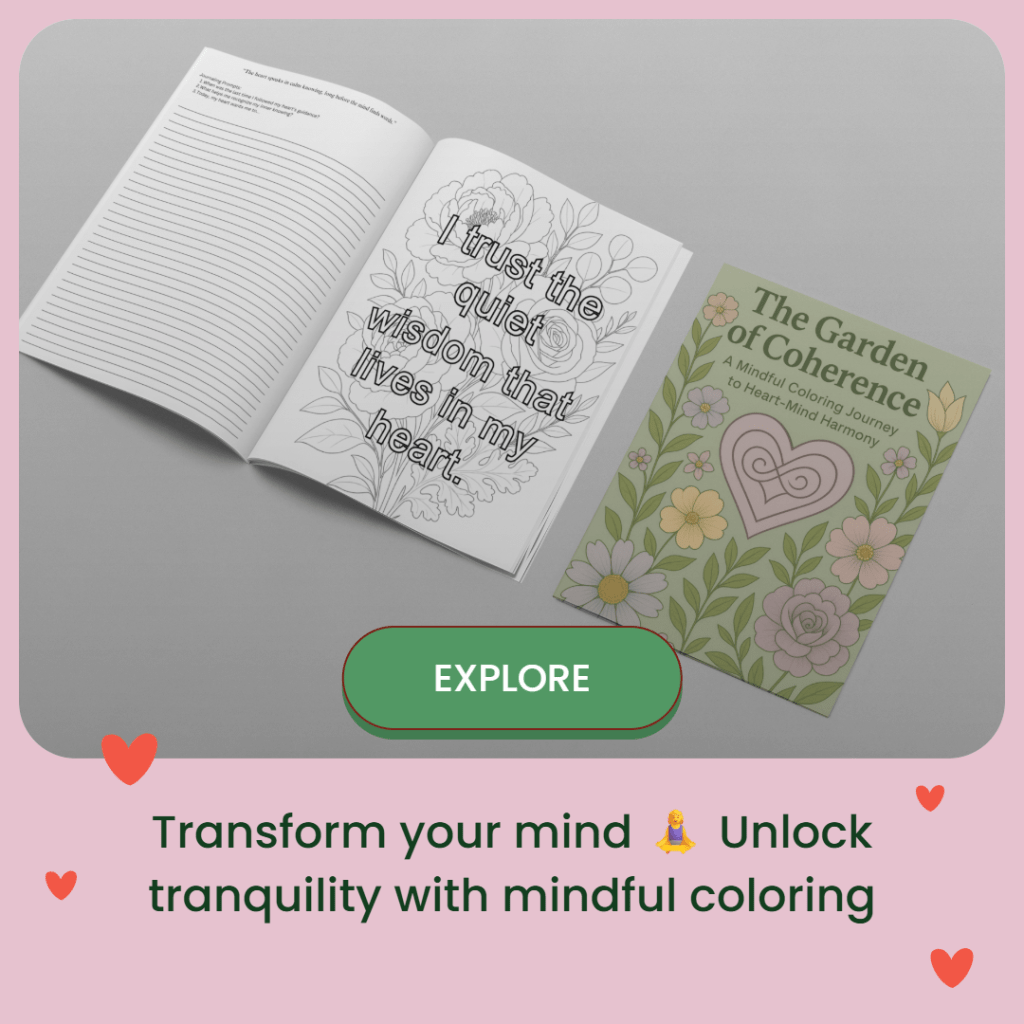
The Garden of Coherence was created to help you rediscover that balance. This mindful coloring journey merges breath, focus, and creative flow to gently bring your heart and brain into sync—a measurable, science-backed state called coherence.
When practiced regularly, coherence restores clarity, calm, and emotional stability. Through art and mindfulness, you begin to experience what it feels like when your inner world moves in rhythm with peace.
The Science of Heart-Brain Coherence
Your heart and brain are in constant communication through the vagus nerve and electromagnetic signals. When you’re anxious or stressed, these signals become erratic, sending “chaos” throughout your body. But when you slow your breathing and shift your focus to gratitude or calm awareness, the heart’s rhythm steadies—and the brain responds in kind.
The HeartMath Institute describes coherence as “the optimal state in which the heart, mind, and emotions are aligned and in sync.” Studies show that coherence improves focus, strengthens emotional regulation, and enhances overall well-being (McCraty & Childre, 2010).
Mindful coloring creates a similar effect. As your attention centers on rhythm, repetition, and color, your breathing naturally slows. This shift increases heart rate variability (HRV)—a sign of a healthy, adaptive nervous system. Improved HRV has been linked to lower anxiety, greater resilience, and better emotional control.
In other words, coloring is more than creativity—it’s a neural exercise in balance and self-regulation.
The Neuroscience of Mindful Coloring
When you color mindfully, your brain enters a meditative state similar to what occurs during mindfulness or breathwork. The prefrontal cortex, responsible for focus and decision-making, becomes active, while the amygdala, associated with fear and stress, calms down.
At the same time, the brain releases dopamine—the neurotransmitter that boosts pleasure and motivation. This helps replace anxious thought loops with positive reinforcement, promoting a sense of accomplishment and inner peace.
A study published in the Art Therapy Journal found that just 45 minutes of creative activity significantly reduced cortisol, the body’s primary stress hormone (Kaimal et al., 2017).
By engaging both hemispheres of the brain—the analytical left and the creative right—coloring integrates logic with emotion, creating harmony between thought and feeling. This balance is the foundation of coherence.
The Power of Breath and the Nervous System
Breath is the bridge between body and mind. Every emotion changes the way we breathe—and every breath changes how we feel.
When you practice slow, steady breathing (around six breaths per minute), your heart rhythm synchronizes with your breath, a phenomenon known as respiratory sinus arrhythmia. Research in Frontiers in Psychology shows that this rhythmic breathing pattern enhances HRV and activates the vagus nerve, leading to improved emotional regulation and resilience (Lehrer & Gevirtz, 2014).
In The Garden of Coherence, each coloring session invites you to pair your movements with the breath—inhale as you fill the space, exhale as you release tension. Over time, this rhythmic synchronization between breath, heart, and brain rewires your nervous system toward calm and clarity.
The Role of Intention and Affirmation in Rewiring the Brain
Your brain changes in response to what you repeatedly think, say, and do—a principle known as neuroplasticity. When you combine mindful coloring with intentional affirmations like “My heart and mind move in harmony,” you strengthen the neural circuits that support peace and focus.
Neuroscientific studies in Frontiers in Human Neuroscience have shown that goal-oriented thought—like setting a clear emotional intention—activates the prefrontal cortex and limbic system simultaneously, aligning cognition and emotion.
This means each time you sit with The Garden of Coherence, you’re not only calming your body—you’re retraining your brain to associate stillness with safety and presence.
Affirmations reinforce these patterns through language. When repeated in a relaxed, coherent state, they move from conscious thought to subconscious belief, becoming your new emotional baseline.
How Multi-Sensory Coloring Creates Whole-Body Regulation
Coherence isn’t achieved through thinking—it’s experienced through the senses. That’s why The Garden of Coherence engages multiple sensory pathways to anchor you in the present moment.
- Visual: The gentle repetition of patterns relaxes the mind and improves focus.
- Tactile: The movement of your hand across the page grounds your body in rhythm.
- Auditory: Steady breathing creates an inner sound of calm.
- Cognitive: Reflection and journaling help integrate emotional insights.
These combined sensory experiences activate both hemispheres of the brain and create cross-modal regulation—a full-body alignment of thought, emotion, and physiology.
Over time, this practice teaches your nervous system to remain balanced even under pressure, making coherence not just a state you visit, but a way of being.
The Benefits of Practicing Coherence
1. Emotional Stability
Mindful coloring and breathwork reduce anxiety and reactivity, allowing you to respond to life from a grounded, centered space.
2. Cognitive Clarity
Coherence enhances focus and strengthens neural connections related to attention and problem-solving.
3. Improved Heart Health
Increased HRV through coherence practices supports cardiovascular wellness and resilience.
4. Stress Recovery
Engaging the parasympathetic system lowers cortisol and helps the body recover from emotional or physical stress.
5. Lasting Inner Peace
Through daily repetition, coherence becomes self-sustaining—a rhythm of presence that supports emotional and physical harmony.
How to Use The Garden of Coherence
- Set Your Intention
Begin by asking: What do I need more of today—peace, clarity, or focus? Let your answer guide your session. - Color with Awareness
As you color, match your breath to your movement. Inhale as you begin a stroke, exhale as you complete it. - Repeat the Affirmation
Whisper or think your affirmation as you color—this repetition rewires thought patterns toward calm and coherence. - Reflect and Journal
Write down how you feel afterward. Over time, these reflections become powerful markers of growth. - Carry Coherence Forward
Keep your affirmation visible—on your mirror, desk, or phone background—as a reminder that peace is your natural rhythm.
Each session becomes a micro-practice in alignment, teaching your body and mind to work as one.
Frequently Asked Questions
1. What is heart-brain coherence?
It’s a physiological state where your heart and brain rhythms synchronize, resulting in emotional balance, clarity, and reduced stress.
2. Can coloring really help me reach coherence?
Yes. Research supports that creative focus, rhythmic motion, and mindful breathing activate the parasympathetic system and promote coherence.
3. How often should I practice?
Even 10–15 minutes a day can build lasting change. Coherence grows stronger through consistency, not duration.
4. Is there scientific evidence behind this practice?
Absolutely. Peer-reviewed studies confirm that coherence techniques improve HRV, reduce cortisol, and enhance emotional well-being.
5. What if I find it hard to relax at first?
That’s normal. The more you practice, the more your nervous system learns that it’s safe to let go and return to calm.
Final Reflection and Call to Action
Coherence is your natural state—it’s what happens when you stop resisting and start breathing with life itself. Beneath every layer of stress and overthinking lies a rhythm of peace, waiting to be remembered.
The Garden of Coherence offers a gentle way back to that rhythm. With each mindful breath and stroke of color, you reprogram your nervous system for harmony and balance.
Each page becomes a meditation in motion.
Each affirmation a whisper of calm.
And each session, a reminder that your peace has always been within reach.
Start your journey to heart-mind harmony today.
Visit ZenfulHabits.com to explore The Garden of Coherence and other mindfulness-based coloring books grounded in neuroscience and emotional healing.




Leave a Reply