
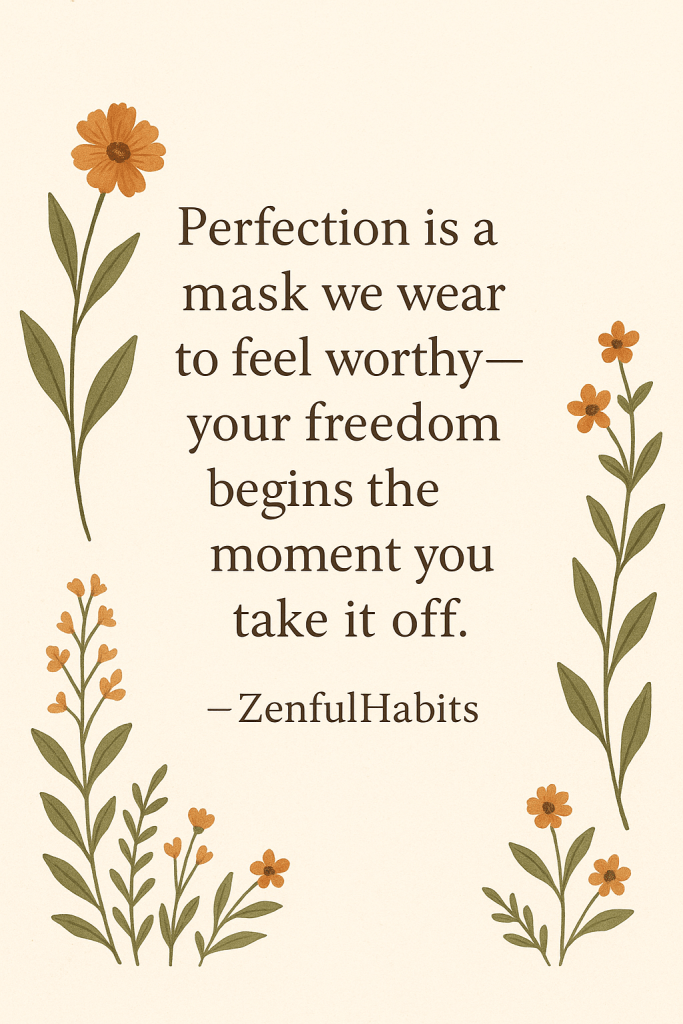
“Perfection is a mask we wear to feel worthy—your freedom begins the moment you take it off.” – ZenfulHabits
Do you often feel like you’re not doing enough or not doing things perfectly? You’re not alone. Many people feel this way, and it’s usually because of perfectionism.
In this article, you’ll learn how to let go of perfectionism in a simple, clear way. You’ll also discover the science behind why it happens and what helps. We’ll explore three gentle practices that can help you feel more free, confident, and calm.
🌱 What Is Perfectionism?
Perfectionism means setting goals that are too high and being very hard on yourself. It’s the idea that you must do everything right or else you’re not good enough.
According to the American Psychological Association, perfectionism is the need to perform at a flawless level, even when it’s not needed.
Some signs of perfectionism include:
- Feeling afraid to make mistakes
- Procrastinating because you want it to be perfect
- Being very self-critical
- Tying your worth to what you achieve
🧠 Why Is It So Hard to Let Go of Perfectionism?
Perfectionism usually starts when we’re young. You may have learned that being perfect meant being loved, praised, or safe. Over time, that belief becomes a habit.
Researchers Paul Hewitt and Gordon Flett identified three types of perfectionism:
- Self-oriented: being hard on yourself
- Other-oriented: expecting others to be perfect
- Socially prescribed: feeling others expect you to be perfect
Socially prescribed perfectionism is especially harmful. It’s linked to anxiety, depression, and low self-esteem.
🧬The Brain Science Behind Perfectionism
When you feel you must be perfect, your brain goes into stress mode. This activates the amygdala, the part of your brain linked to fear. Your body tenses, your heart rate goes up, and you may feel panic or shame.
However, when you practice self-compassion—being kind to yourself—your brain activates the prefrontal cortex. This part helps you stay calm and make good decisions.
Dr. Kristin Neff’s research shows that self-compassion helps people be stronger, more motivated, and healthier emotionally.
Letting go of perfection doesn’t mean doing less. It means doing things with more kindness and less fear.
💡 How to Let Go of Perfectionism: 3 Simple Practices
Letting go of perfectionism is possible. Start with one of these practices today.
1. Reframe Failure as Feedback
Failure does not mean you’re not good enough. It means you’re learning. Everyone makes mistakes. That’s how the brain grows.
Psychologist Carol Dweck calls this a “growth mindset.” People who believe they can learn from failure are more successful.
Try this: Instead of saying, “I failed,” say, “What did I learn from this?”
Affirmation: “I am allowed to be human. I am learning every day.”
2. Practice Intentional Imperfection
Try doing something imperfect on purpose. It teaches your brain that mistakes are not dangerous.
You can:
- Send a text without over-editing
- Wear two different socks
- Share a thought even if it’s not polished
This is called “exposure.” The more you face your fear, the less power it has.
Affirmation: “I don’t need to be flawless to be lovable.”
3. Use a Journaling Prompt
Journaling helps you understand what’s underneath your perfectionism. It also helps calm your mind.
Prompt: “What would I try if I didn’t have to be perfect?”
Don’t edit. Just write. Let yourself be real.
Affirmation: “I am enough just as I am.”
📄 Want a printable page for this practice? Download the journaling page here.
💬 What Happens When You Let Go of Perfectionism
Letting go of perfectionism can feel like taking a deep breath after holding it in for years. You no longer have to prove your worth or hide your flaws. Instead, you begin to live more fully and freely.
As a result, you may start to:
- Rest without feeling guilty
- Try new things without the fear of failure
- Speak honestly without overthinking
Most importantly, you begin to enjoy life for what it is—not what it should be.our life more.
🧘 Final Reflection
Perfectionism is not a personality trait—it’s a learned coping mechanism. And anything learned can be unlearned.
With intention, kindness, and a little courage, you can quiet the inner critic and live from a place of real peace.
Start today with one simple act of self-compassion. Choose to show up as you are, not as you think you “should” be.
Because who you are—right now—is already enough.
🔄 Coming Next:
You Are Enough: How to Rewire the Inner Voice That Says Otherwise
In our next article, we’ll explore how to shift your self-talk and build a more loving inner voice.
Stay tuned!
Continue your journey with more powerful reads from our collection:
- Soul‑Led Love: Building Connections Without Ego Attachments
- The Art of Acceptance: Embracing People Where They Are
- How to Love Unconditionally Without Sacrificing Your Own Needs
- Love Without Judgment: Insights from A Course in Miracles
- Breathwork for Self-Compassion: A Mindful Practice for Loving Yourself and Others
- How Practicing Gratitude Deepens Your Ability to Love and Accept




Leave a Reply